Agentic-RAG-vLLM-inference
Agentic RAG with Colocated vLLM Inference
Project Description
This project compares the performance of Agentic RAG, traditional RAG, and standalone LLM systems when answering technical questions about the Hugging Face ecosystem.
All inference has been moved from remote API calls to a GPU cluster with colocated vLLM serving. The framework features both online (server) and offline (batch) vLLM inference within a unified cluster, engineered for zero-egress data sovereignty, localized compute efficiency, and high-throughput RAG workflows.
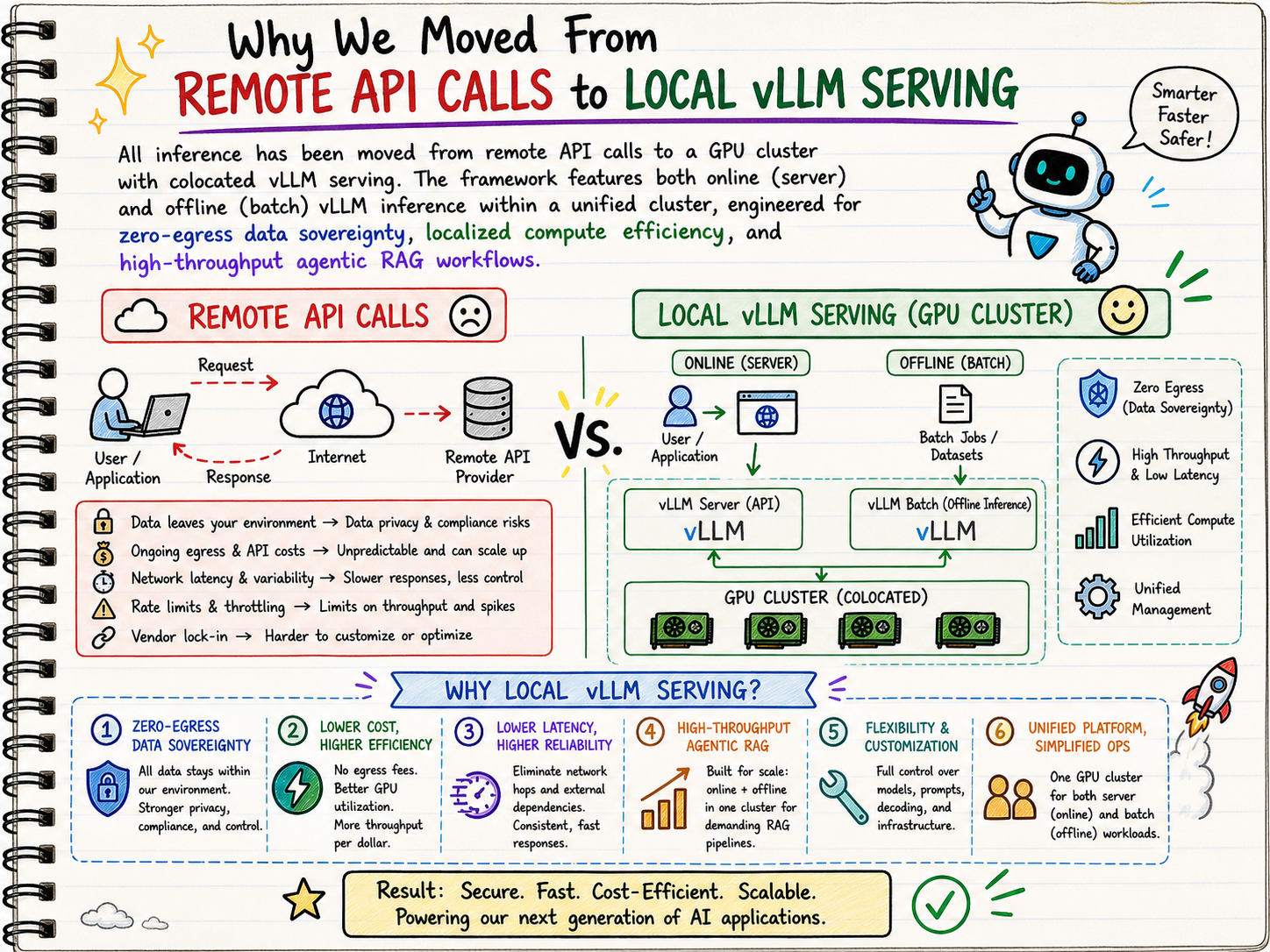
While traditional RAG systems follow a fixed retrieve-then-generate pattern, this project introduces an agent-based approach that enables dynamic decision-making, iterative query refinement, and adaptive tool use. The agent intelligently interacts with external knowledge sources, evaluates retrieved content, and refines its strategy based on outcomes, resulting in more accurate, robust, and contextually rich answers. The agentic framework is built with smolagents.
Pipeline Architecture
The evaluation runs as a three-phase hybrid pipeline that maximises GPU utilisation on HPC:
| Phase | Mode | What it does |
|---|---|---|
| Phase 1 — Offline Batch | vllm.LLM.generate() |
Standard RAG + Vanilla LLM inference (maximum throughput, zero HTTP overhead) |
| Phase 2 — Async Server | vLLM server + asyncio |
Concurrent Agentic RAG — N agents query the vLLM server in parallel; continuous batching keeps GPU near 100% |
| Phase 3 — Offline Batch | vllm.LLM.generate() |
LLM-as-judge evaluation of all answers |
Key Capabilities
| Capability | Description |
|---|---|
| Query Strategy & Refinement | Strategically determines and combines keywords for search queries, iteratively refining them based on retrieval results to optimize relevance and coverage. |
| Iterative Query Refinement | If initial retrieval is insufficient, the agent reformulates queries or expands the number of retrieved documents. |
| Document Evaluation | Assesses the relevance and quality of retrieved information relative to the question before generating an answer. |
| Multi-step Reasoning | Chains together multiple retrieval and generation steps to answer complex questions. |
| Self-Correction & Backtracking | If a generated answer is unsatisfactory, the agent devises and executes alternative retrieval strategies. |
Installation
Prerequisites
- Python 3.12+
- CUDA-capable GPU(s) (tested on NVIDIA H100)
- vLLM (included in requirements)
- Git
- uv
Steps
- Clone the repository
git clone https://github.com/Wen-ChuangChou/Agentic-RAG-vLLM-inference.git cd Agentic-RAG-vLLM-inference - Create and activate a virtual environment (recommended)
python -m venv .venv source .venv/bin/activate - Install dependencies
uv pip install -r requirement.txt - Download a model (if not already cached)
# Example: download a model to the HuggingFace cache
bash hpc/download_model.sh <model_id>
Usage
1. Configure a Model Recipe
Each model is configured via a YAML recipe in recipes/. A recipe controls the model, vLLM server, judge, async concurrency, and vector database settings:
ls recipes/
# GLM-4.7-Flash.yaml  Llama-3.3-70B-Instruct.yaml  MiniMax-M2.7.yaml
# Qwen3.5-122B-A10B-FP8.yaml  Qwen3.6-35B-A3B-FP8.yaml  ...
See recipes/Qwen3.5-122B-A10B-FP8.yaml for a full example with comments.
2. Run the Evaluation Pipeline
On an HPC cluster (recommended)
Submit the Slurm job, optionally specifying a recipe:
# Default recipe (GLM-4.7-Flash)
sbatch hpc/run_agentic_rag.slurm

# Custom recipe
sbatch hpc/run_agentic_rag.slurm recipes/Qwen3.5-122B-A10B-FP8.yaml

# Test mode — run on specific question IDs only
sbatch hpc/run_agentic_rag.slurm recipes/Qwen3.5-122B-A10B-FP8.yaml --test-ids 4 12 20 49 56
The Slurm script handles module loading, optional local staging, and environment variable setup. Submit from the repository root.
Use node-local storage on HPC
The following options independently control what is copied to a job-specific directory under /tmp. Both are disabled by default.
| Option | What uses local storage |
|---|---|
--local-env |
A copy of .venv, plus fresh FlashInfer, vLLM, TorchInductor, and Triton compilation caches. All three phases and the vLLM server use the copied Python environment. |
VLLM_USE_NVME=true |
Copies of the main and judge model weights, resolved from explicit model paths or the existing Hugging Face cache. |
Place --local-env before the recipe path. Set VLLM_USE_NVME=true before sbatch:
# Local Python environment and compilation caches; weights stay at their original paths
sbatch hpc/run_agentic_rag.slurm --local-env recipes/Qwen3.6-35B-A3B-FP8.yaml

# Local model weights only
VLLM_USE_NVME=true sbatch hpc/run_agentic_rag.slurm recipes/Qwen3.6-35B-A3B-FP8.yaml

# Local Python environment, compilation caches, and model weights together
VLLM_USE_NVME=true sbatch --time=01:00:00 hpc/run_agentic_rag.slurm \
  --local-env recipes/Qwen3.6-35B-A3B-FP8.yaml

# The same setup with selected questions
VLLM_USE_NVME=true sbatch --time=01:00:00 hpc/run_agentic_rag.slurm \
  --local-env recipes/Qwen3.6-35B-A3B-FP8.yaml --test-ids 4 20 43 49
Staging copies files; it leaves the original environment and weights intact. Code, the vector database, logs, checkpoints, and results remain in the workspace. If no local model source is found, weight staging is skipped and normal model resolution applies. VLLM_LOCAL_ENV=true can also enable environment staging instead of the --local-env flag.
Local Python staging reduces import delays caused by slow shared-filesystem access. Job-local compilation caches prevent reuse of build files containing an earlier job’s temporary paths. Allow time for copying and fresh kernel compilation as well as all three evaluation phases; the one-hour example is not a runtime guarantee. The main script removes its temporary environment, caches, and staged weights on normal exit or a caught setup failure, while preserving workspace outputs. Forced termination such as SIGKILL can bypass cleanup.
Locally
python agentic_rag.py --config recipes/GLM-4.7-Flash.yaml

# Test mode — first 5 questions only
python agentic_rag.py --config recipes/GLM-4.7-Flash.yaml --test 5
What the pipeline does:
- Builds (or loads from cache) a FAISS vector database from the Hugging Face documentation corpus
- Phase 1: Runs Standard RAG and Vanilla LLM via offline batch inference (
vllm.LLM) - Phase 2: Launches a vLLM server and runs concurrent Agentic RAG queries via
asyncio - Phase 3: Scores all answers with an LLM judge via offline batch inference
- Saves results to
results/<model_name>_vect<chunk_size>_t<temperature>.json
All phases write checkpoints to
checkpoints/so long runs can be safely resumed.
Vector database pipeline (utils/vectordb_utils.py):
| Feature | Detail |
|---|---|
| Parallel splitting | Documents split concurrently via ThreadPoolExecutor for large-scale speed-up |
| Batch embedding | Embeds in configurable batches (default 100), merging FAISS shards incrementally to manage memory |
| Thread-safe processing | DocumentProcessor uses threading locks to prevent race conditions |
| Intelligent fallback | Automatically falls back to sequential processing if parallel execution fails |
| Deduplication | Removes duplicate documents by content hash before indexing |
| Persistent caching | Saves/loads the FAISS index from vectordb/ to skip expensive recomputation on repeat runs |
[!TIP] Use a GPU to create the vector store. Embedding generation is heavily compute-bound: on this dataset a GPU completes the full build in ~14 seconds (H100), while a CPU takes more than 23 minutes (AMD 5600x). If a GPU is available, ensure your
torchinstallation is CUDA-enabled — the pipeline will use it automatically.
3. Visualize Results
Performance Scores
Generates a grouped bar chart comparing the mean accuracy (%) of Agentic RAG, Standard RAG, and Vanilla LLM across all result files.
python visualize_rag_performance.py
python visualize_rag_performance.py --results_dir path/to/results
Output: results/evaluation_scores.png
Score Distribution
Generates a stacked bar chart showing the proportion of Correct, Partially correct, and Wrong answers for each system type and model.
python visualize_correct_portion.py
python visualize_correct_portion.py --results_dir path/to/results
Output: results/score_distribution.png
Inference Time Comparison
Compares running time between remote API calls and local vLLM inference serving.
python visualize_time_comparison.py MiniMax-M2.7 Qwen3.5-122B Qwen3.6-35B
Output: results/time_comparison.png
Project Structure
Agentic-RAG-vLLM-inference/
│
├── agentic_rag.py                  # Main 3-phase evaluation pipeline
├── visualize_rag_performance.py    # Grouped bar chart of mean accuracy scores
├── visualize_correct_portion.py    # Stacked bar chart of score distribution
├── visualize_time_comparison.py    # API vs vLLM inference time comparison
├── requirement.txt                 # Python dependencies
│
├── recipes/                        # Model configuration recipes (YAML)
│   ├── GLM-4.7-Flash.yaml
│   ├── Llama-3.3-70B-Instruct.yaml
│   ├── MiniMax-M2.7.yaml
│   ├── Qwen3.5-122B-A10B-FP8.yaml
│   └── Qwen3.6-35B-A3B-FP8.yaml
│
├── utils/                          # Core modules
│   ├── agent_tools.py              # RetrieverTool for the smolagents CodeAgent
│   ├── async_agentic_runner.py     # Concurrent agentic RAG via asyncio + threading
│   ├── model_factory.py            # Model creation factory
│   ├── offline_runner.py           # Offline batch inference via vllm.LLM
│   ├── vllm_server_manager.py      # vLLM server lifecycle context manager (Phase 2)
│   ├── checkpoint_runner.py        # Checkpointing logic for long evaluations
│   ├── results_manager.py          # Save / load evaluation results to JSON
│   └── vectordb_utils.py           # FAISS vector database (gte-small embeddings, parallel build, persistent cache)
│
├── hpc/                            # HPC / Slurm scripts
│   ├── run_agentic_rag.slurm       # Main Slurm job script (3-phase pipeline)
│   ├── launch_vllm_server.sh       # Standalone vLLM server launcher
│   ├── launch_vllm_multinode.sh    # Multi-node vLLM server launcher
│   ├── download_model.sh           # Model download helper
│   ├── setup_vllm_env.sh           # vLLM environment setup
│   └── test_phase1.slurm           # Phase 1 unit test job
│
└── prompts/                        # YAML prompt templates
    ├── gemini_agent_system_prompt.yaml
    ├── guide_agent_system_prompt.yaml
    └── evaluation_prompt.yaml
Results
Performance was evaluated using the Hugging Face technical Q&A dataset with all inference running on a local GPU cluster via vLLM.
Inference Time: API vs Local vLLM
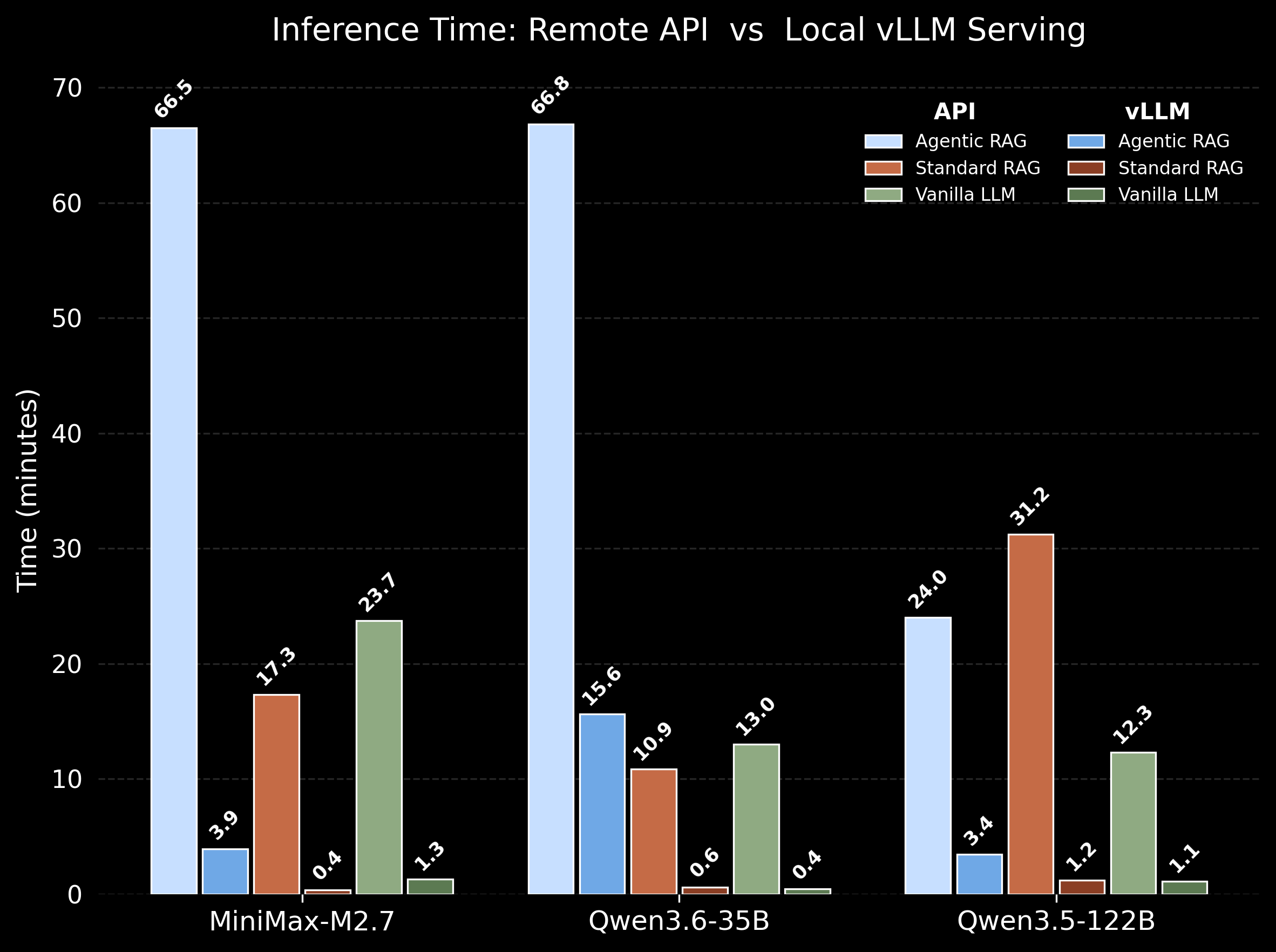
The API vs. vLLM results show that system design, not just modeling approach, determines whether advanced pipelines are viable. Under remote APIs, latency is dominated by per-call overhead, so Agentic RAG becomes prohibitively slow due to many sequential requests. In contrast, on a local vLLM server, the concurrent Agentic RAG setup—multiple agents issuing requests in parallel—combined with continuous batching keeps GPU utilization near saturation and amortizes decoding costs across requests. This collapses end-to-end latency by an order of magnitude and makes multi-step reasoning pipelines not only feasible but efficient.
For Standard RAG and Vanilla LLM, the use of offline batching further highlights this systems effect. While APIs penalize even modest multi-call workflows, local batching executes large query sets in parallel with minimal overhead, bringing their runtimes close to the lower bound of pure model compute. As a result, the latency gap between Standard RAG and Vanilla LLM nearly disappears locally, while Agentic RAG remains somewhat higher due to additional steps—but still within a practical range. Overall, we demonstrate that concurrency + batching (either in agentic, RAG, or Vanilla LLM) are the key enablers, transforming both simple and complex pipelines from API-limited latency regimes into compute-efficient, high-throughput local systems.